
Simultaneous Noise Immission Measurements
Measuring Several Immission Points Simultaneously Under TA Lärm
Where plant operation varies, we record the noise immissions at several immission points at the same time. This is particularly useful when operating conditions fluctuate, occur only rarely or are difficult to reproduce.
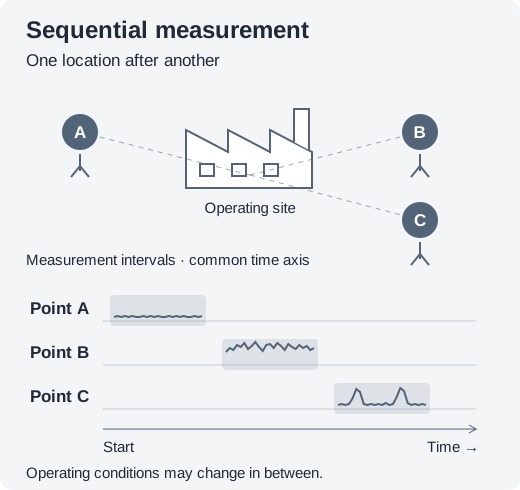
Loading operations, changing production steps or the start-up of a plant cannot always be repeated under the same conditions. If the immission points are measured one after another, different operating phases may enter the results.
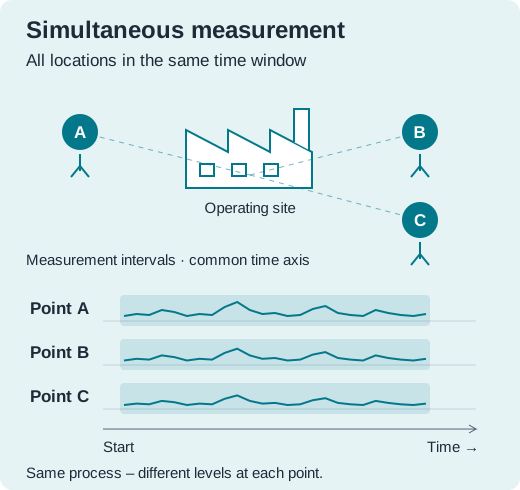
In a simultaneous measurement, all measurement points capture the same operating sequence in time. This allows noise events to be assigned across locations and evaluated together. The levels will still differ depending on distance, screening and local influences.
Sequential and Simultaneous Measurement Compared
Both approaches have their place. Where operation is uniform, a sequential measurement may be appropriate. Where operation varies, simultaneous recording offers a particular advantage for comparing the immission points.
Typical Tasks
Industry and Production
A production line starts up, several units run together or a particular process occurs only intermittently. Simultaneous measurement captures the effects at several immission points within the same period, for example during:
- Start-up and shut-down operations
- Changing production and load conditions
- Rare events that are relevant to the task at hand
Logistics and Handling
Deliveries, shunting and loading activity change over the course of a shift. A joint measurement campaign makes the relationships over time traceable across different neighbouring areas, for example with:
- Fluctuating delivery and loading activity
- Night-time operations
- Several affected neighbouring areas
Suitability and scope of measurement are determined for the specific site.
Advantages of Simultaneous Recording
- Results comparable in time: all immission points are recorded during the same operating sequence.
- Coherent analysis of events: measurement data and documented operating events can be compared over time.
- Coordinated organisation: relevant operating phases may need to be repeated less often for individual measurement locations.
Simultaneity alone does not make a measurement more accurate or less expensive – it does not replace proper measurement planning and assessment in accordance with TA Lärm. We take into account in particular the relevant operating conditions, measurement locations and times, the weather and extraneous noise.
Depending on the task, we deploy experts at the measurement points to document observations and noise events on site. Whether and to what extent this is necessary is clarified during measurement planning.
Course of a Measurement Campaign
1. Clarify the Task
We review the site plan, the description of operations and any existing conditions, and together with you define the relevant operating conditions, immission points and scope of investigation. The number of measurement points and their staffing depend on the task and the local conditions.
2. Measure Simultaneously
We agree the measurement periods and bring the instruments onto a common time reference. Operating sequences, on-site observations and boundary conditions are documented for the subsequent evaluation.
3. Evaluate Together
We combine the time histories, check the assignment of events and assess the results within the agreed scope in accordance with TA Lärm. The procedure is explained in the measurement report.
Measurement Technology and Data Integration
Data acquisition and integration are tailored to the specific task. The measurement system developed together with the Lärmzentrale may also be used; its range of functions then depends on the agreed measurement concept.
“Simultaneous” refers to recording at several locations at the same time, not to the duration of the measurement. Such a campaign is usually limited in time. Whether continuous monitoring is useful beyond that depends on the question at hand.
Our further services under TA Lärm – from the noise immission forecast through to acceptance measurements – are described under Industrial & Commercial Noise.
Planning a Measurement Campaign
Helpful documents for coordination are a site plan showing the neighbouring areas to be considered, a description of the operating sequences and operating hours, and any existing permits, conditions or acoustic investigations. Together we then define the scope of investigation, the measurement period and the staffing of the measurement points.